
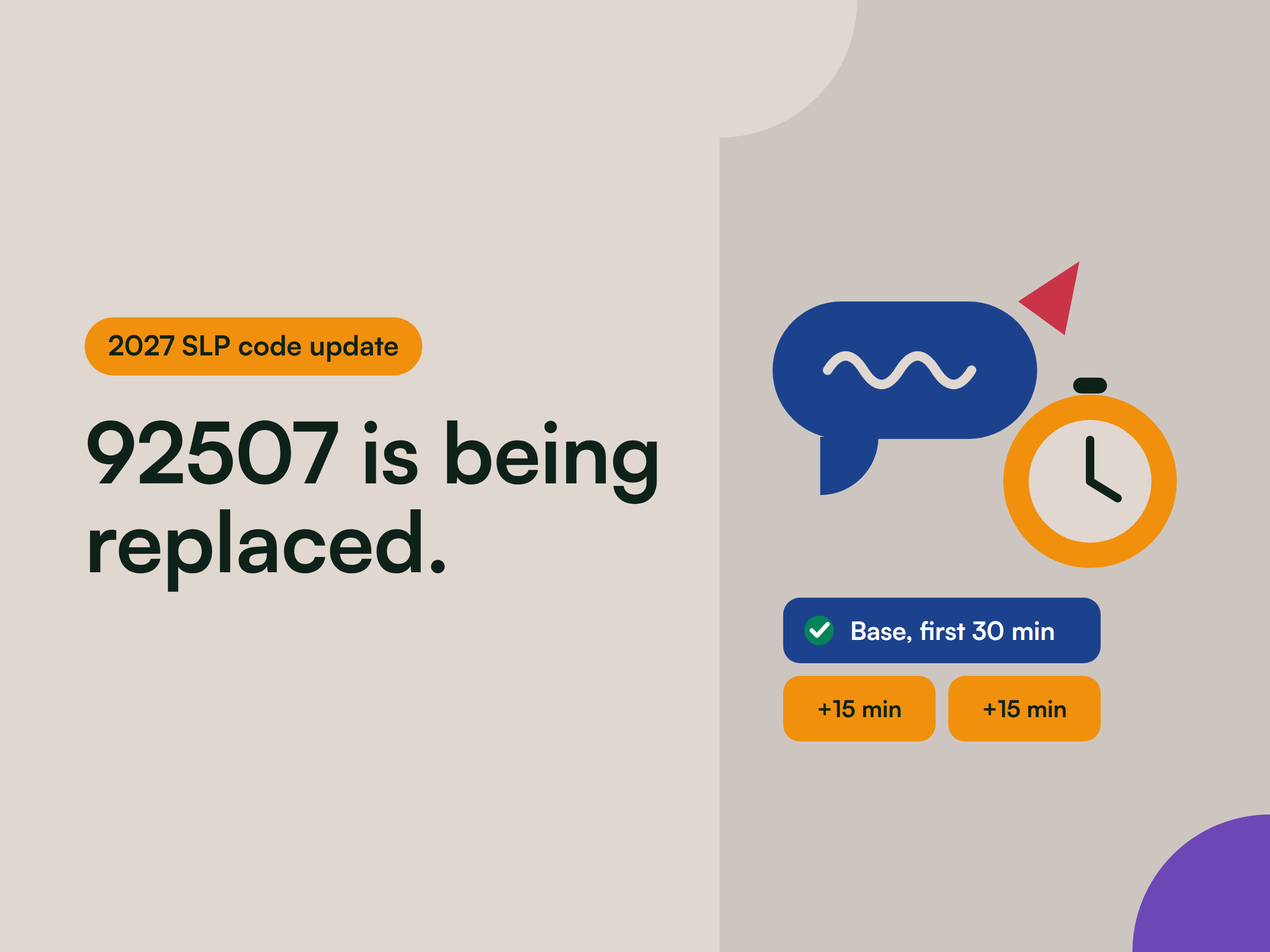
The new speech therapy CPT codes for 2027 replace 92507 on January 1. One untimed code becomes ten timed codes, sorted by what's being treated.
This update covers what's known about the new codes as of mid-October, what isn't known yet, what the change could mean for a clinic, and what to look for in an EMR before payers move.
1. What's happening to 92507
CPT 92507 has covered nearly all individual speech treatment as one untimed code. ASHA reports that CMS and the AMA flagged it in 2024 through a high-volume growth screen, after Medicare billing for the code rose sharply. That set off a review through the CPT and RUC processes.
The new code family takes effect January 1, 2027. Each of five treatment areas gets a base code for the first 30 minutes of one-on-one treatment and an add-on for each additional 15 minutes.
Through December 31, 2026
Starting January 1, 2027
- Early November 2026Medicare final rule expected, with final rates and a decision on GSLPP
- January 1, 202792507 deleted and the timed codes take effect
- Fluency. Stuttering and cluttering. Base 92654, add-on 92655.
- Speech sound production. Articulation, phonology, apraxia, and dysarthria. Base 92656, add-on 92657.
- Language comprehension and expression. Receptive and expressive language. Base 92658, add-on 92659.
- Combined speech sound production and language. A child with both articulation and language goals, for example. Base 92660, add-on 92661.
- Voice, upper airway dysfunction, and resonance. Vocal nodules or vocal fold paralysis, for example. Base 92662, add-on 92663.
ASHA's guidance applies the CPT midpoint convention. A base code can typically be billed once 16 minutes are reached. An add-on needs the full 30-minute base plus at least 8 more minutes, 38 in all, and payer policies can differ.
CMS also proposed a Medicare-only pediatric code, GSLPP, valued off 92507 and built around 60 minutes of treatment. It was written for Medicare, and our read is that Medicaid and commercial payers are unlikely to adopt it.
2. What isn't changing around 92507, and what isn't known yet
Only individual treatment under 92507 changes. Several details that decide the impact haven't been published.
Not changing
- 92508 group treatment stays untimed, with a revised descriptor.
- Evaluations 92521 through 92524 don't change.
- 92526 and 92610, 97129 and 97130, and AAC codes 92607 through 92609 stay as they are.
Not known yet
- Final Medicare rates. CMS's proposed values can still move. ASHA expects the final rule in early November, and other payers often take their cue from it.
- NCCI and MUE edits. These decide which new codes can be paid together on one date of service, and whether a modifier can separate them. ASHA expects them before year end.
- The payment reduction. CMS proposed applying the multiple procedure payment reduction to the five base codes. Under Medicare, it halves the practice expense portion of each additional same-day therapy service. Whether it's finalized isn't known.
- GSLPP. Whether CMS finalizes the pediatric code, and in what form.
- Payer adoption. State Medicaid programs and commercial insurers aren't required to adopt the new codes or Medicare's rates, and few have said publicly when they will.
3. What it could mean for your clinic
How much this affects a clinic depends on how long its visits run. Under 92507, Medicare paid one rate per session, about $76 nationally in 2026 before locality adjustment, whether the visit ran 20 minutes or 60.
Under the new codes, time drives the pay. Clinics built around 30-minute visits are the most exposed, because a 30-minute session bills one base code, and every proposed base code pays less than that 2026 rate. Many of these clinics keep visits at 30 minutes because their rates don't support longer ones, not because every child needs only 30.
A 30-minute visit
A 60-minute visit
Clinics that see many children for an hour may come out ahead on the proposed numbers. A 60-minute combined speech sound and language session, billed as one base code and two add-ons, comes to about $127 at proposed national rates. That assumes no other therapy that day and comes before locality adjustment and the final rule, and other payers' rates will differ.
Longer visits also change the admin load, since fewer children for similar revenue means fewer authorizations and statements to manage. Still, every clinic's mix of visit lengths will land differently.
There's also talk across the field about billing two different base codes in one session, such as fluency and speech sound production. CPT's own instructions rule out pairing the separate speech sound and language codes, which is what the combined code is for. Whether other pairs pay depends on NCCI edits that aren't out yet, and each service has to be distinct, clinically appropriate, and meet its own time.
4. Will payers be ready on January 1?
The closest comparison is 2017, when the single PT and OT evaluation codes, 97001 and 97003, each split into three complexity levels. Payers picked that up fairly quickly. It was a simpler swap, and Medicare valued all three levels the same as the old code.
This change moves an untimed service to timed billing and reprices it, so our read is that adoption will be slower and uneven. State Medicaid programs may need a budget review first, and the window between the final rule and January 1 is short.
- Early November 2026
Medicare final rule. Final rates for the new codes, and decisions on the payment reduction and GSLPP.
- Before year end
NCCI and MUE edits. Which new codes can be paid together on one date of service.
- January 1, 2027
New codes take effect. 92507 is deleted from CPT.
- After January 1
Payers move on their own schedules. Some may keep recognizing 92507 for a time.
Old codes also linger. TheraPlan's billing team, EEP Billing Services, has seen one state workers' compensation fee schedule keep the retired evaluation codes for years after 2017. ASHA notes some payers may recognize 92507 until their systems catch up, so a clinic may bill it to one payer and the new codes to another.
5. What an EMR should do to support clinics
No EMR can know every payer's adoption date, and none should guess. It can put the clinic in control and help therapists pick the code each payer will take. Look for these from any vendor, alongside the basics in our speech therapy EMR guide.
A payer-level code setting. The clinic should be able to mark, payer by payer, whether that payer takes the new codes or still takes 92507, and flip it when the payer moves.
A prompt at the note. When a therapist documents for a child whose payer hasn't switched, the EMR should say so before the note is signed. Nobody checking out a full caseload can remember which payer wants which code.
Time captured per code. The note should record direct treatment minutes for each service, since time from one service can't count toward another.
Clear descriptions of the new codes. Therapists will be choosing among five areas for the first time.
Date-of-service logic. 92507 shouldn't appear for dates on or after January 1, 2027, unless the clinic has marked that payer as still taking it.
In EEP's experience, therapists kept choosing retired codes after past code changes, and every fix meant reopening and editing a signed note, since a biller can't simply swap the code on the claim. That's the part that turns a coding change into a pile of rework.
Where TheraPlan fits, with EEP Billing Services
As TheraPlan's billing service, EEP handles claims for many clinics, so it sees which payers are paying the new codes once claims start processing, a view a clinic billing on its own doesn't get. When a claim carries a code that payer isn't taking, EEP holds it and tells the clinic, instead of sending it out to be denied. TheraPlan tracks coding and payer change so owners who are clinicians first don't have to become policy analysts. This update will follow the final rule.
Learn more about TheraPlanFrequently asked questions
When does 92507 go away?
January 1, 2027. CPT 92507 is valid through December 31, 2026, and timed codes 92654 through 92663 take over individual treatment after that. A payer that hasn't updated its fee schedule may still accept 92507 for a time.
Can two base codes be billed in one session?
It isn't settled yet. Speech sound and language treatment in one session goes on the combined code. For other pairs, the answer waits on NCCI edits due in late 2026, and each service must be distinct and clinically appropriate.
Do Medicaid and commercial payers have to use the new codes on January 1?
No. Each Medicaid program and commercial plan sets its own policy and doesn't have to follow Medicare's codes or rates. Most are expected to say little until the Medicare final rule, due in early November 2026.
This article reflects TheraPlan's reading of publicly available guidance as of October 14, 2026. It is not legal, billing, or clinical advice. Codes, coverage, rates, and payer requirements change and vary by state, plan, and contract. Verify current requirements with the payer and the relevant agency before you act, and consult a qualified professional for your specific situation. Medicare payment values for the new codes, the multiple procedure payment reduction for them, and HCPCS code GSLPP were proposed, not final, as of this date. Statements attributed to EEP reflect the client experience of TheraPlan's EEP Billing Services team and are not published industry findings.